AI Does the Junior Work Now. So How Does Anyone Get In?
The entry-level squeeze is real, but the answer is not to wait for the old ladder to come back. It is to become fluent enough to run the agents doing the junior work.


The doom version goes like this. AI eats the junior work, the bottom rung disappears, and in ten years nobody has trained the seniors. Tidy, and the numbers underneath it are real enough that I understand why people tell it. I just do not think it is where this lands.
What makes me hesitate is how quickly these tools became easy. Agentic systems like Claude Cowork and Perplexity Computer now run genuine automations across real files and workflows, and pointing one at a task no longer takes a specialist. That is precisely the capability chewing through entry-level work, and also something a motivated graduate can learn in a month.
The squeeze itself is not in doubt, and the sharpest numbers are American. Graduate hiring there is up 5.6 per cent this year (NACE 2026), while Stanford’s payroll analysis found a 16 per cent relative fall in employment for workers aged 22 to 25 in the most AI-exposed occupations, even as older workers in those same roles held steady (Brynjolfsson, Chandar and Chen 2025). Different instruments, payroll against surveys, so they do not stack neatly, which is part of why the aggregate looks calm. Across 2.4 million entry-level US job ads, PwC found AI-exposed junior roles seven times more likely to demand traditionally senior skills, with those seniorised roles growing 35 per cent since 2019 while ordinary entry-level postings fell 10 per cent (PwC 2026).
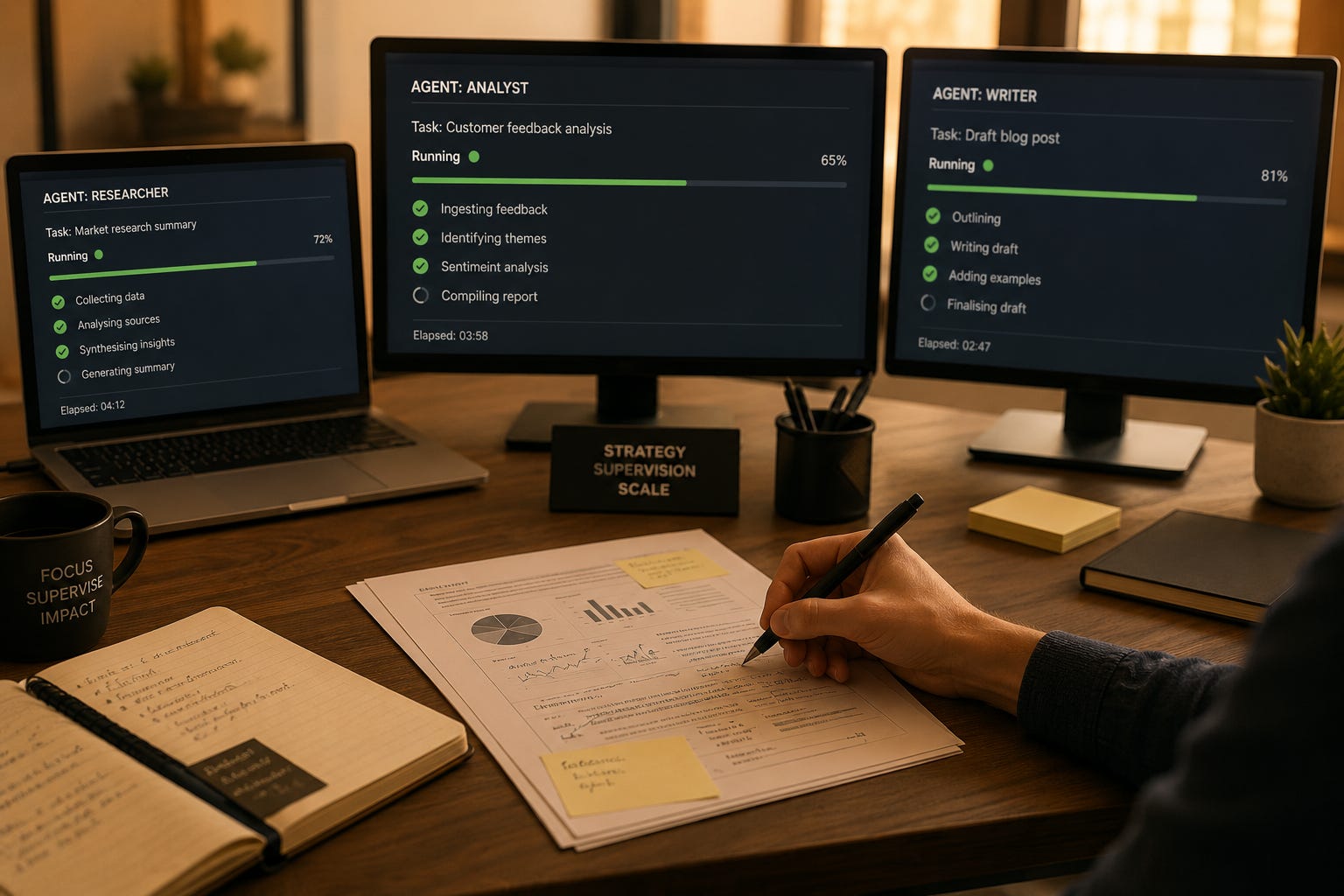
Read that as a door closing and you miss what it says. Employers are asking juniors to arrive able to do what used to take five years, and for the first time there is a plausible route there, because the grind a graduate once worked through can now be handed to an agent they direct and check. The valuable skill was never producing the boilerplate; it is knowing what to ask for and whether what came back is right.
Employers are already paying for that. Jobs demanding AI skills are growing roughly eight times faster than the rest, 69 per cent against 9 per cent, and carry a 62 per cent wage premium (PwC 2026). Eighty-five per cent of this year’s graduating class already use AI (Handshake 2026). They are not waiting for permission.
So the honest advice to anyone starting out is not to hope the old ladder returns. Get fluent enough to run the agents doing the junior work, and the mid-level rung arrives sooner than it used to. Things are moving quickly.
Better to be an expert in AI than to ignore it and hope for the best.
Views expressed are my own and do not represent those of my employer.
References
Brynjolfsson, E, Chandar, B & Chen, R 2025, Canaries in the coal mine? Six facts about the recent employment effects of artificial intelligence, Stanford Digital Economy Lab, 13 November, viewed 21 July 2026, https://digitaleconomy.stanford.edu/publication/canaries-in-the-coal-mine-six-facts-about-the-recent-employment-effects-of-artificial-intelligence/
Handshake 2026, AI and the workforce ahead for the Class of 2026, Handshake, viewed 21 July 2026, https://joinhandshake.com/research/economic-research/class-of-2026-ai-outlook/
National Association of Colleges and Employers (NACE) 2026, Outlook brightens for college Class of 2026 entry-level hiring, NACE, 27 April, viewed 21 July 2026, https://www.naceweb.org/about-us/press/2026/outlook-brightens-for-college-class-of-2026-entry-level-hiring
PwC 2026, 2026 Global AI Jobs Barometer, PwC, 15 June, viewed 21 July 2026, https://www.pwc.com/gx/en/news-room/press-releases/2026/pwc-2026-ai-jobs-barometer.html